Draw a Circle Photoshop Cs5
Step-by-Footstep Tutorial
Create A New Document In Photoshop
First, locate the top of the Photoshop workspace.
Select File and within the File drop down tab, select New… to create a new document.
The New Document window will appear which allows the new document to be customized.
Within the New Certificate window, observe that the right side of the window is where the Preset Details gives unlike options to create the new document.
Adjacent to Width, notice how Photoshop is going to mensurate the size of the document. The document can exist measured and sized in numerous means such as by pixels and inches.
Select the driblet-down arrow and select Inches.
Inside the Width and Height boxes, type in 10 as the width and height.
In the Color Fashion drib-down, select RGB.
Inside the Background Contents drop-down tab, select white equally the color that will be the background.
In one case the correct settings are gear up, hitting Create.


A white 10 x ten certificate will appear in the Photoshop workspace.
Create A Circumvolve: Using the Elliptical Marquee Tool
The Elliptical Marquee Tool creates a moving outlined option of the created shape to then be customized. Although an elliptical shape is not evenly round, a Photoshop shortcut will allow the shape to turn into a perfect circle.
Locate the left side of the workspace where the Tool Bar is located.
The Tool Bar allows admission to multiple tools to be used to customize an image.
The Elliptical Marquee Tools is located within the Rectangular Marquee tab in the Tools Panel. This tool is identifiable by a dotted lined rectangle shaped symbol, which is located on the right side of the Move Tool at the top of the Tools Panel.
Once located, select and hold the Rectangle Marquee Tool.
The Marquee Tool side tab will appear revealing unlike Marquee Tool shapes.
Select the Elliptical Marquee Tool, which is the 2nd tool in the tab.
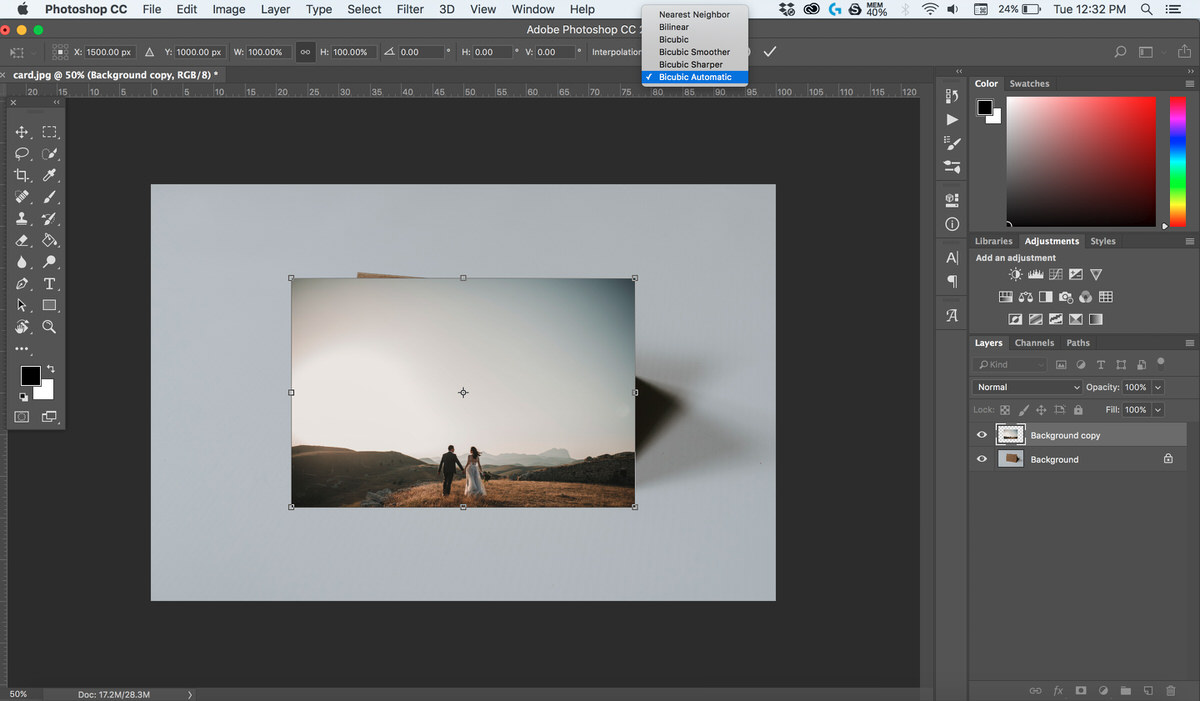
Now that the tool is selected, find how the mouse symbol has turned into a plus-shaped symbol.
Locate the meridian of the workspace where the Elliptical Marquee Tool can be customized.
Detect the various foursquare symbols, one foursquare by its self, 2 merged together etc. Each of the symbols represents how the marquee tool will exist used on the new document. If the mouse is positioned over each squared symbol, Photoshop explains how it can add, subtract, or interest with a choice. In this example select the atypical filled in square, which represents New Selection.
The Feather option, allows the edges of the shape to have a soft edge with a higher number or a difficult edge with a low number.
For this circumvolve, set Feather at 0 so the circle will not accept a soft edge.
Select the checkbox for Anti-alias, which allows edges of a shape to exist polish.
Lastly, select the Blending Style to Normal.
The Blending Fashion tells Photoshop how the object should collaborate with the certificate.
With the cursor positioned towards the upper left corner, click and drag the mouse to the bottom right corner while holding Shift on the keyboard.
Past belongings Shift, this allows a perfect circle to be created. If Shift is not held, the circle will wait more like an oval.
Detect how the circle has a dotted moving outline.
Now, click and drag the circumvolve so that it is positioned in the center.
two.2 Elliptical Marquee Tool: Fill Circle With Brush Tool
Locate the left side of the workspace where the Tool Bar is located.
Within the Tool Bar, locate the Brush Tool, which is recognizable by a brush shaped symbol and is located underneath the Eyedropper Tool.
Select the Castor Tool or try the Brush Tool keyboard shortcut by hitting B on the keyboard.
Once the Brush Tool is selected discover the top of the workspace where the Brush Tool tin can be customized.
Locate the Brush Presets at the top left corner of the workspace where a preview of the current brush style is viewable along with a number below it indicating the size of the brush.
Select the arrow next to the Brush Preset.
The Brush Preset will announced which allows the brush to be customized.
The first task is to select the brush.
At the lesser of the Brush Presets tab is an array of brushes to select from.
In this case, select the very first round brush because the settings are going to exist customized.
On the meridian of the tab are the Size and Hardness options.
By moving the slider nether Size, the brush volition become larger with a larger number and smaller with a smaller number.
The Hardness pick indicates how harsh or soft of an edge the brush will have.
With the Hardness at 100%, the castor will take a solid outline just if the hardness is set at 25%, the brush will accept a soft outline.
Set the Size to 900 px and the Hardness to fifty%.
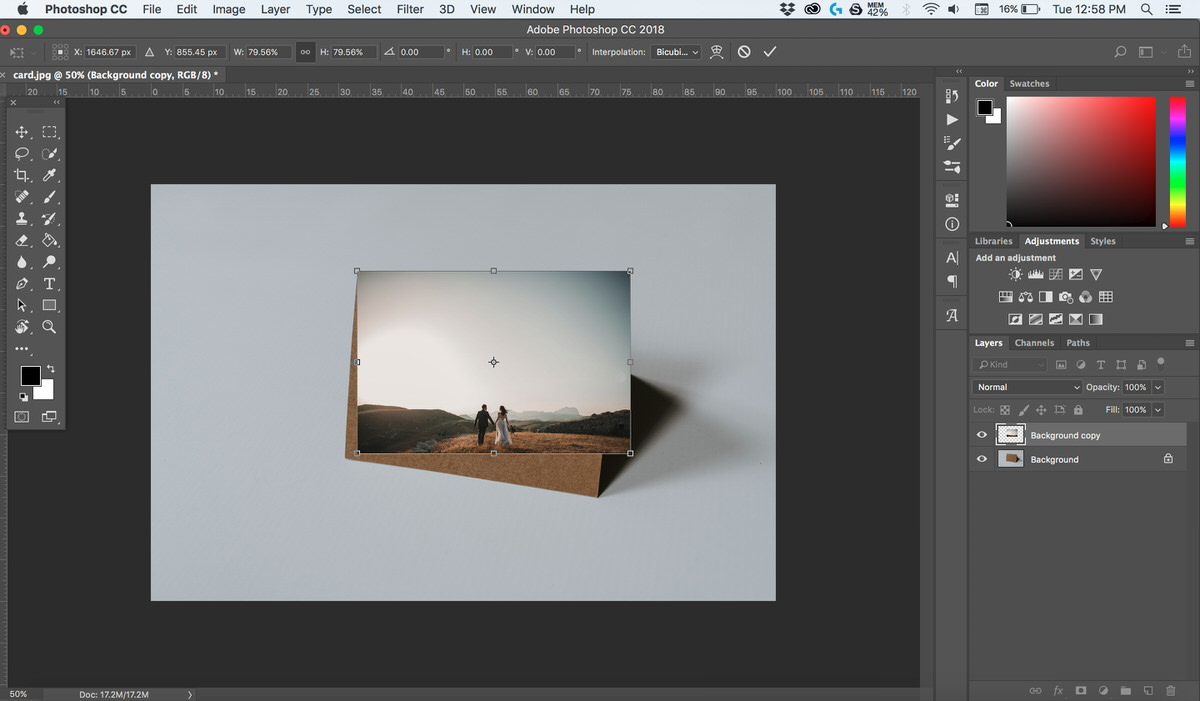
Once selected, hibernate the Brush Presets tab just unselecting the Brush Preset driblet-downward arrow.
Discover how there are two colored boxes at the bottom of the Tool Bar.
The color on the pinnacle represents the foreground colour and the color backside it represents the background color.
Double-click on the foreground color.
The Color Picker (Foreground Color) window volition announced.
The Colour Picker window reveals a variety of colors to cull from or to type in the color code at the bottom of the window.
In this example, select a dark-green color.
Once selected, hitting OK.
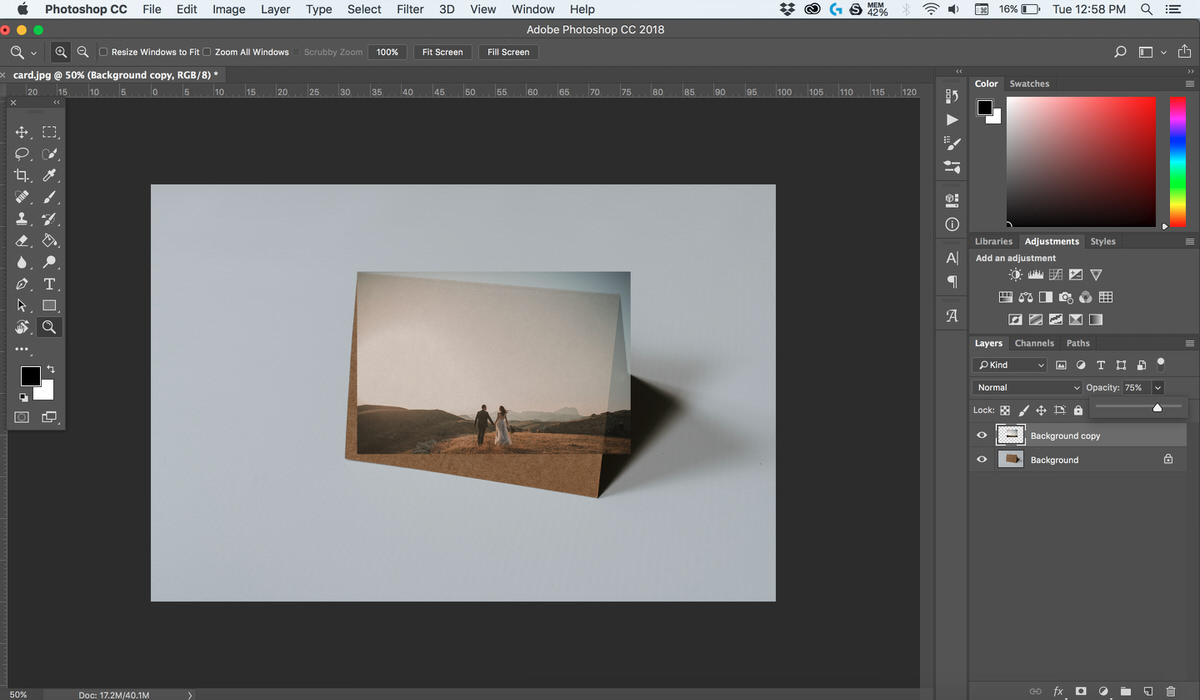
Now, simply click and elevate the mouse over the circle until the entire circle is filled.
If the brush is too large or too modest go back to the height of the workspace within the Brush Preset tab and adjust the size or try using the [ and ] keys on the keyboard to suit to the desired size.
Once selected, the green colour will announced in the circle.
To remove the selection around the circumvolve, locate the top of the workspace.
Click Select and in the drop-downward window select Deselect.
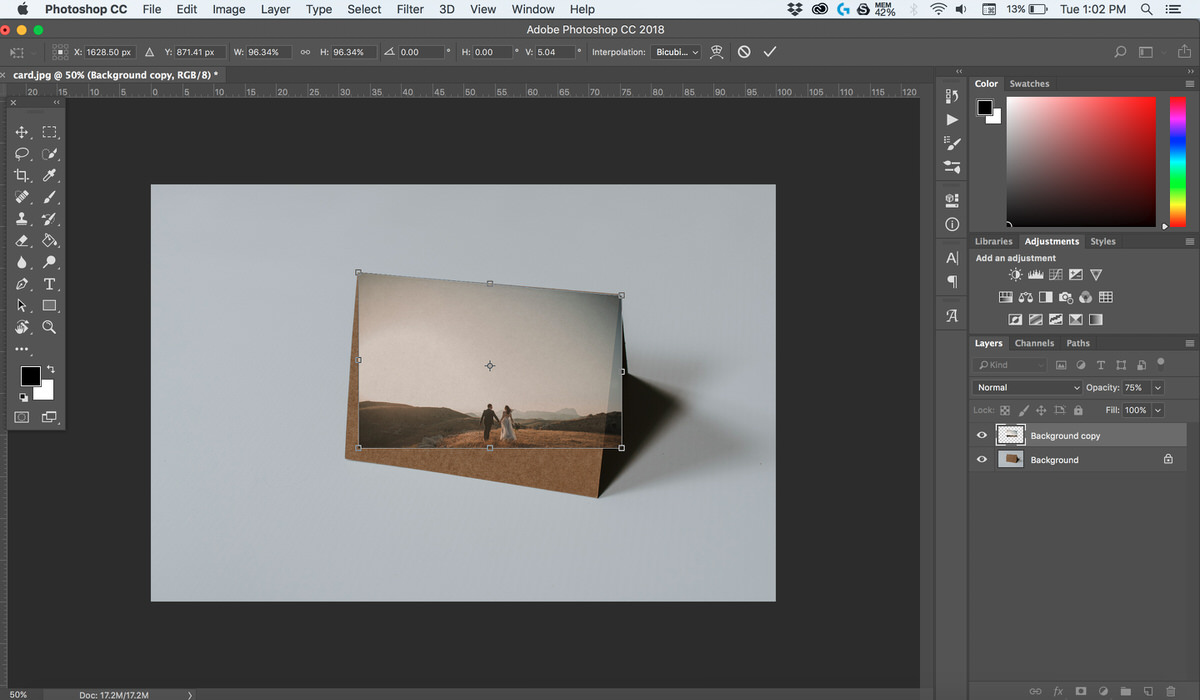
The moving outline will disappear.
2.3 Elliptical Marquee Tool: Fill Circle with Paint Bucket Tool
Locate the left side of the workspace where the Tool Bar is located.
Within the Tool Bar, locate the Gradient Tool, which is recognizable past a blackness to white gradient square shaped symbol.
Once located, select and hold the Slope Tool until the side tab appears.
The Paint Saucepan Tool will appear as the second tool in the tab.
Select the Paint Bucket Tool.
Once selected, notice the top of the workspace where the Pigment Saucepan Tool tin exist customized.
The starting time section, which is the Source to Fill indicator, asks how the object should be filled. This allows the foreground color or a pattern to be filled into the option. In this case, choose Foreground.
Gear up the Fashion to Normal so the colour will fill with no alterations.
Set Opacity to 100% and then the colour will fill with a solid colour.
Set Tolerance to 0.
Notice how there are two colored boxes at the bottom of the Tool Bar.
The colour on the height represents the foreground color and the color underneath represents the background color.
Double-click on the foreground color.
The Color Picker (Foreground Color) window will announced.
The Color Picker window reveals a variety of colors to choose from or to type in the colour code at the lesser of the window.
In this case, select a purple color.
One time selected, hit OK.
Now, simply position the mouse over the circumvolve and click to fill circle with color.
The circle will at present be filled in with purple.
To remove the selection effectually the circumvolve, locate the acme of the workspace.
Click Select and in the driblet-downwards window select Deselect.
The moving outline will disappear.
2.4 Elliptical Marquee Tool: Make full Circle with Gradient Tool
The Gradient Tool allows multiple colors to be applied and composite together in i sequence. In this case, a gradient will exist practical to a circle to have a unique wait.
Locate the left side of the workspace where the Tool Bar is located.
Within the Tool Bar, locate the Gradient Tool, which is recognizable by a black to white gradient square shaped symbol.
Select the Slope Tool or try the shortcut past hitting G on the keyboard.
Locate the superlative of the workspace where there are different options to customize the Gradient Tool.
Notice the black to white slope box at the top. This is chosen the Gradient Picker where the gradient volition be selected.
Select the pointer beside the Gradient Picker to reveal the different gradients to cull from.
Select the rainbow slope, which is called Spectrum.
Next to the Gradient Picker are Gradient Style options.
Past hovering the mouse over each square, Photoshop will indicate how the gradient will be placed in a sequence.
In this example, select the first box which is the called the Linear style.
The Linear style volition present the slope in one straight sequence.
Set up the Mode to Normal so the color will fill with no alterations.
Set Opacity to 100% and then the fill up will exist solid.
At present, with the mouse positioned on the left side of the circle, click and elevate the mouse all the way over the circle.
As the mouse is dragged, notice a line will announced indicating which mode the slope will get.
Once the mouse is on the right side of the circle, release the mouse.
The rainbow gradient will appear in the circumvolve in the aforementioned sequence in the Slope Picker.
Effort clicking and dragging the mouse over the circle in different directions to meet the different directions the slope tin be directed.
To remove the selection effectually the circle, locate the peak of the workspace.
Click Select and in the drop-down window select Deselect.
The moving outline will disappear.
Create a Circle: Using the Ellipse Tool
The Ellipse Tool creates a solid outlined selection of the created shape to so be customized to have color fill the shape or accept an outline effectually a shape. This tool allows a circle to be customized within the same tool. Although an ellipse shape is not evenly circular, a Photoshop shortcut will allow the Ellipse Tool to turn the tool into a circle tool.
Locate the left side of the workspace where the Tool Bar is located.
The Tool Bar provides multiple tools to be used throughout Photoshop.
The Ellipse Tool is a tool that is located inside the Rectangle tab in the Tools Bar, which is identifiable past a rectangle shaped symbol. This tool is located above the Magnify Tool at the bottom of the Tools Bar.
Once located, select and hold the Rectangle Tool.
A side tab will appear revealing different shaped tool that can exist used.
Select the Ellipse Tool, which is the 2d tool in the tab.
Locate the top of the workspace where the Ellipse Tool can exist customized.
Select the Tool Mode, which is located at the meridian left corner.
Fix the Tool Manner to Shape.
This will specify that the apply for creating a circle is for creating a shape.
The Fill option allows the circle to be with or without fill up. This allows the circumvolve to be filled with a solid color, gradient or pattern.
In this instance set the fill to none, which is indicated by the white box with a carmine line across it.
Next to the Fill is Stroke, which indicates how to outline the circle. This selection is like to Fill because it allows the circle to be outlined with no color, a solid color, a gradient or a pattern.
In this case, select the circumvolve to be outlined to no make full, which is indicated by the white box with a blood-red line across it.
Beside Stroke, select the width of the stroke to 0 pt.
The Ellipse option allows a circle to be outlined or a circumvolve to have a dotted outline.
With the cursor positioned towards the upper left corner, click and drag the mouse to the bottom right corner while property Shift on the keyboard.
By holding Shift, this allows a perfect circle to be created. If Shift is non held, the circle will turn into a oval shape.
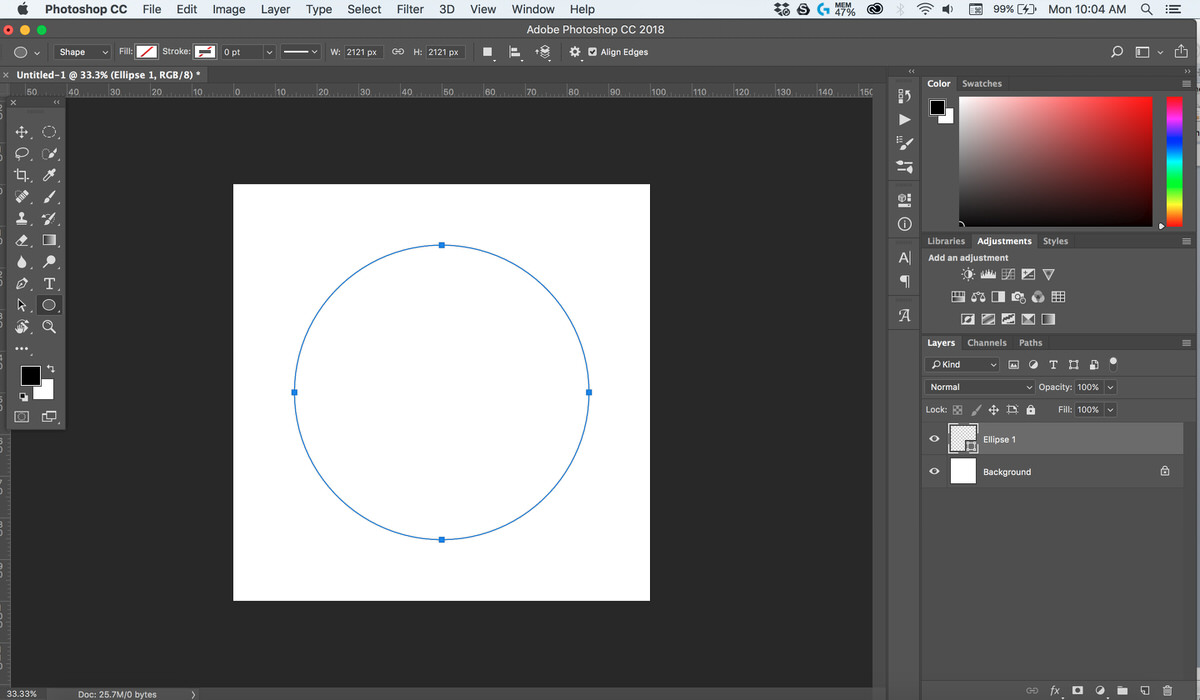
Observe how the new shape has created a new layer called Ellipse 1 in the Layers Console on the correct side of the workspace.
Since the shape has its own layer, the shapes can be customized at any fourth dimension.
3.2 Ellipse Tool: Outline And Fill In Circle With Solid Color
With the Ellipse 1 layer selected, which is located on the right side of the Layers Panel, select the Ellipse Tool.
Notice the options to customize the circle at the top of the workspace.
Locate and select Fill for the drop-downwards tab to appear.
Next to No Fill, indicated past the white box with a red line across, is the solid black foursquare, which indicates to fill the circle with a solid colour.
Select the solid black box.
Photoshop will automatically fill a color into the foursquare with the terminal color used in Photoshop.
To change the color of the circle, locate the top correct corner of the Fill tab where a multicolored box is located. This is called the Color Picker, which allows any color to be selected to fill the circle.
Select the Colour Picker.
The Color Picker (Fill Color) window will appear.
The Color Picker window reveals a variety of colors to cull from or to type in the color code at the lesser of the window.
In this case, select a light bluish color.
Once selected, striking OK.
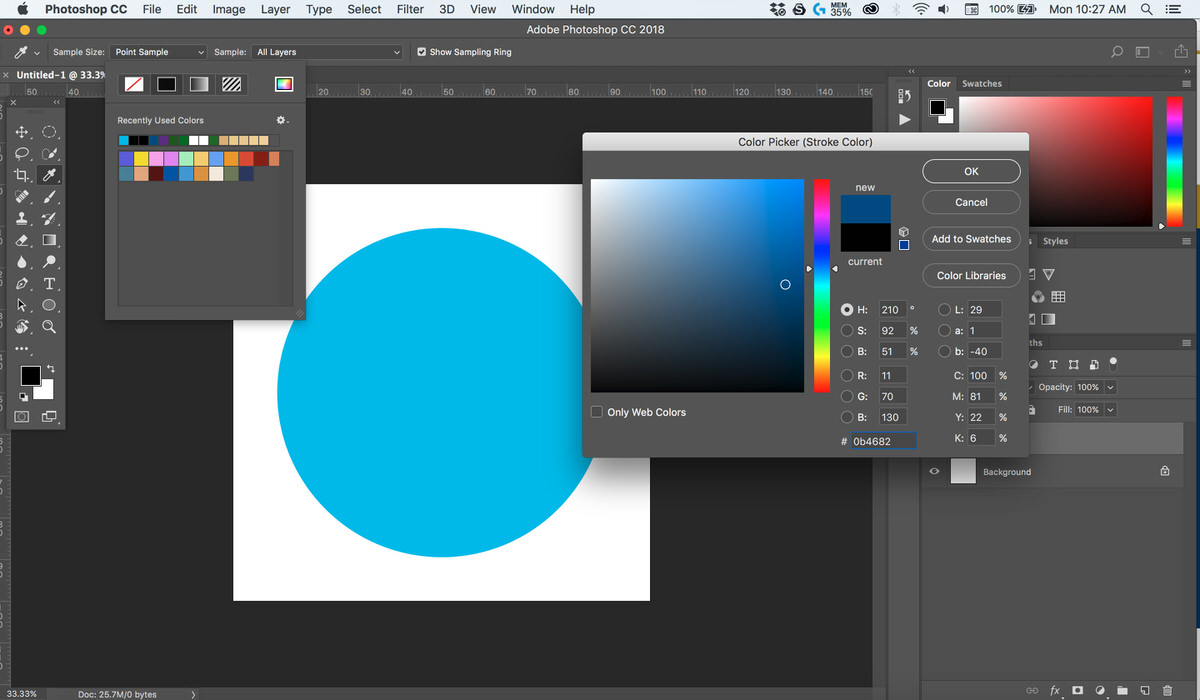
Notice how the circle is filled in with the selected color.
Next to Fill, select Stroke for the drop-down tab to announced.
Adjacent to No stroke, indicated by the white box with a red line beyond, is the solid black square, which indicates to fill the circle with a solid colour.
Select the solid black box.
Photoshop volition automatically fill a color into the foursquare with the final color used in Photoshop.
To change the outline color of the circle, locate the elevation right corner of the Stroke tab where a multicolored box is located. This is called the Color Picker, which allows whatever color to be selected to fill the outline.
Select the Color Picker.
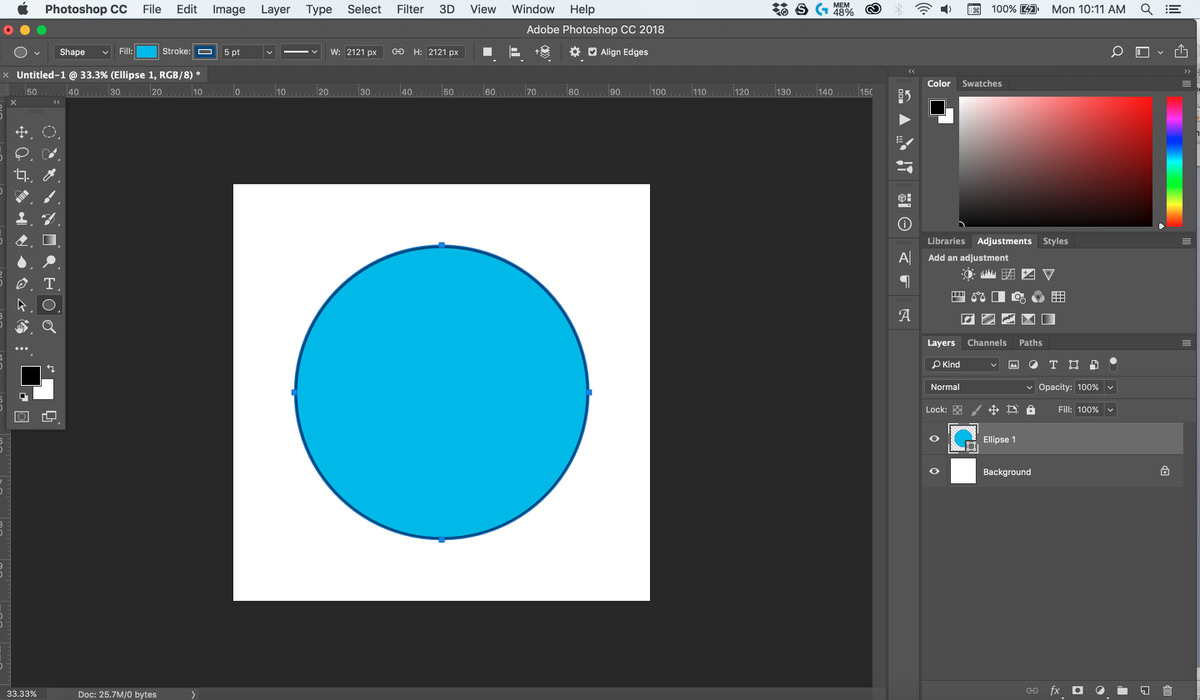
The Colour Picker (Stroke Colour) window will appear.
The Color Picker window reveals a variety of colors to choose from or to type in the colour code at the bottom of the window.
In this example, select a night blueish color.
Once selected, hit OK.
Notice how the circle is filled in with the selected color.
Now, next to Stroke blazon in 5 pt as the width of the line.
Ready Shape Stroke Blazon to a solid line, which is located next to the Stroke width setting.
iii.3 Ellipse Tool: Fill In Circumvolve With Slope
With the Ellipse ane layer selected, which is located on the right side of the Layers Panel, select the Ellipse Tool.
Notice the options to customize the circle.
Locate the Make full selection at the top of the workspace.
Select Fill up then the drib-down tab appears.
Next to No Make full, indicated past the white box with a red line across, is the black gradient square, which indicates to fill the circle with a gradient.
Select the gradient option, which is side by side to the solid black box.
Photoshop will automatically fill the circle with a slope.
Photoshop will provide different colored gradients to fill up, which can be selected or customized to create a new slope.
To customize a slope, detect the Slope Editor Dialog that automatically presents a black to white gradient bar.
The Gradient Editor Dialog bar allows any colors to exist selected,the opacity, and the flow of the gradient to exist customized.
Notice the height pointer above the gradient dialog bar.
The peak arrows above the slope betoken where the opacity starts and stops in the gradient.
Opacity indicates how much of the colour will be present. For example, if the Opacity is ready to fifty%, then the force of the color volition over be 50%. This will allow other items behind the gradient to be viewable.
The bottom arrows indicate where each colour starts and stops in the gradient.
If the color on the left is more desired, but move whatever lesser arrow to the right or left to accept more of that color.
Now, notice a small circle on the lesser of the slope.
This indicates the Color Midpoint, which is where two colors merge. This allows the option fro one color to dominate the other in the gradient.
Double-click on the bottom left arrow to modify the color.
The Color Picker (Color Stop) window will appear.
Select an orange color and hit OK.
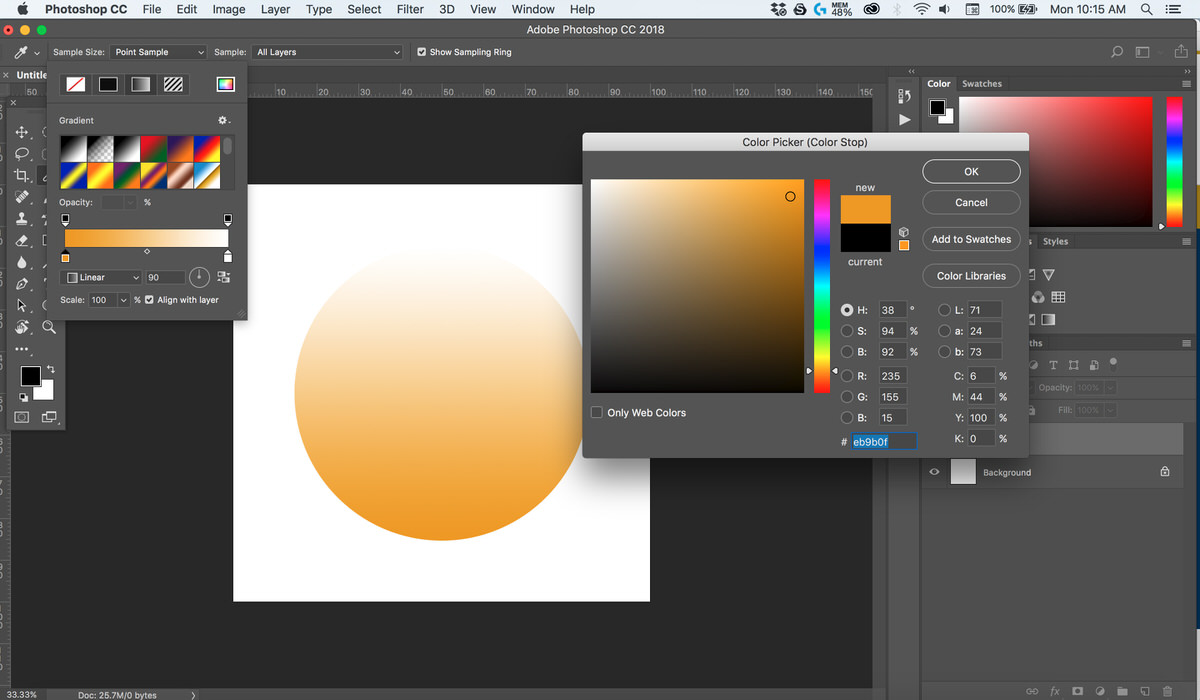
Notice how the gradient has filled the circle.
The selected color will now fill the left side of the gradient dialog.
Now, click and elevate the bottom Color Terminate arrow to the right.
Observe how the color fills more of the gradient.
Now, movement the Color Midpoint circle on the lesser of the gradient dialog bar to the right.
Find how the circle'southward gradient is affected.
Now, double-click on the lesser right arrow beneath the slope dialog.
The Color Picker (Colour Finish) window volition appear.
Select a blue colour and striking OK.
Locate the Linear option below the gradient dialog bar.
This indicates the mode of the gradient.
To modify the style, merely click the tab and select the style.
The numbered box next to the Gradient Style allows the angle of the style to exist specified. In this case, Photoshop has automatically set the bending to 90 degrees.
Another way to point the bending is past the circle located in the numbered angle box. With the line directed towards the elevation of the circle, this indicated that the gradient would go down to upwardly.

brinkerhoffhiplace.blogspot.com
Source: https://phlearn.com/tutorial/how-to-draw-a-circle-in-photoshop/

Enregistrer un commentaire for "Draw a Circle Photoshop Cs5"